
Building Before Knowing: When the direction is clear but the path isn't
Weekly reflections on leadership paradoxes and the formation work beneath them


Welcome back to Leading in the Tension.
If you’re new here, this is where we go deeper into the paradoxes of leadership. The tensions we’re tempted to resolve but often need to hold. I’m Josh, and I’ve spent two decades learning (often the hard way) that the best leadership happens not when we eliminate tension, but when we learn to live faithfully within it.
This week, I’m headed to Atlanta for a coaching skills lab that will shape how I serve leaders going forward. The direction has been clear for a while. The how is still revealing itself. And I’ve been sitting with a question that feels personal but might resonate with you too.
There’s a particular kind of tension that shows up when you know you’re supposed to be building something but you can’t fully see what it is yet.
Not confusion. Not paralysis. Something more unsettling.
Forward motion without a map. Conviction without clarity. The sense that something is forming in you, around you, through you, but you can’t name it. You can’t explain it to anyone else. You’re not even sure you could explain it to yourself.
You show up anyway. You build anyway. You take the next step even though you can’t see the step after that.
Part of you wonders if this is faith or foolishness.
I’m in that place right now.
In a couple days, I’ll be in Atlanta for a coaching skills lab. Part of a training that will shape how I serve leaders going forward. I’ve done the pre-work, read the materials, felt the anticipation of becoming someone I’m not yet.
The contours of what I’m building are starting to emerge. I can see smoke rising in the distance, catch glimpses of what might be taking shape, but the full image remains hidden. Something is there. Something true. I can sense it more than see it, and the work now is unveiling rather than grasping, discovery rather than control.
A few weeks ago, I created something I’ve been calling a Milestone Map.
Not a goal list. Not a strategic plan. Not a collection of achievements I’m chasing.
A document that captures who I am becoming, what I refuse to compromise, and what I’m building toward even when I can’t see the destination. It holds my non-negotiables, my formation commitments, the restraints I’ve chosen because focus requires boundaries. It names the values that guide decisions before decisions arrive.
Think of it as a north star rather than a GPS. A GPS tells you exactly where to turn. A north star tells you which direction is true, even when the path underneath your feet keeps shifting.
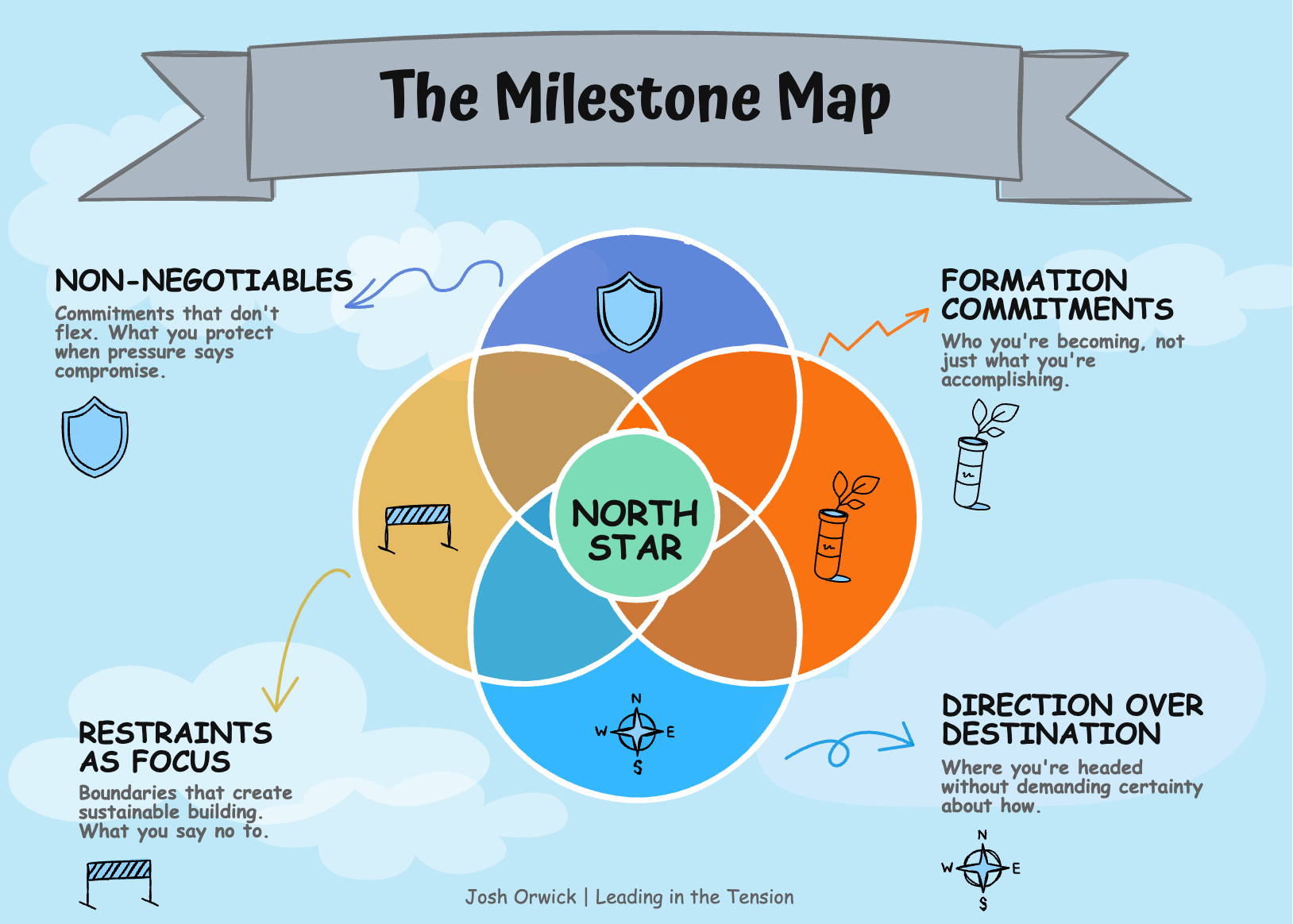
I open that document most mornings before the house wakes up. Coffee going cold on my desk while I remember who I am before the day tries to tell me who I should be.
The Milestone Map is the most whole artifact I’ve ever made. Not because it gives me answers. Because it gives me grounding when answers aren’t available.
I’d love to hear if something like this would be helpful for you. If enough people are interested, I may create a template or guide for building your own.
Last week, I walked into a conversation with an executive team that I’d been preparing for without knowing exactly how to facilitate it. I could see the organizational dynamics. I could feel the tension points. I didn’t have a proven framework. I went anyway.
The conversation opened something I couldn’t have designed. Not because my approach was perfect. Because I showed up on solid ground when the path wasn’t clear.
Maybe you know this feeling.
The project you’re building that you can’t fully explain yet. The transition you’re navigating that doesn’t fit into a neat narrative. The sense that you’re becoming someone, moving toward something, but the words for it haven’t arrived.
You’re not lost. You have direction. You have that internal resonance that tells you something is aligning even when you can’t articulate what.
The struggle isn’t absence of purpose. The struggle is building toward purpose before the specifics crystallize.
And no one taught you how to do that.
So we carry it alone. And the weight compounds.
The Weight of Unnamed Tension
The hardest tensions to carry are the ones we can’t name.
When you can name the problem, you can work on it. When you can articulate the challenge, you can strategize around it. When you can explain what you’re feeling, other people can help.
Unnamed tension just sits there. Heavy. Scattered across everything but concentrated in nothing. Present in the background of every decision but impossible to point to directly.
You feel it in the gap between what you’re doing and who you’re becoming. In the distance between your current reality and the direction you sense but can’t validate. In the exhaustion of performing clarity for others when you don’t have it yourself.
That tension isn’t a sign that something is wrong with you. It’s a sign that formation is happening. That you’re in the space between who you were and who you’re becoming.
Until you have language for it, you can’t work with it. You just carry it.
But that weight might not be what you think it is. It might be hope that hasn’t found its words yet. What feels heavy might actually be the pressure of becoming—a self expanding beyond its current container.
The invitation isn’t to escape the tension. It’s to find language for it. And once named, everything shifts.
Why We Demand Certainty Before We’ll Move
There’s a lie underneath the surface that most of us believe without realizing it.
The lie says responsible people don’t move until they can see where they’re going.
So we wait. We plan. We research. We prepare. We tell ourselves we’re being wise when really we’re demanding complete knowledge as a prerequisite for faithfulness.
Your nervous system is doing its job.
The brain is wired to predict and protect. Uncertainty registers as threat. When the path forward isn’t clear, your body responds the same way it would respond to physical danger. The amygdala activates. Cortisol rises. Everything in you says: don’t move until you know it’s safe.
This isn’t weakness. It’s biology.
Bessel van der Kolk’s work in The Body Keeps the Score reminds us that the body remembers. It remembers every time uncertainty led to pain, every time stepping into the unknown resulted in harm. And it tries to protect you from repeating that experience.
Protection and growth require opposite responses.
Protection says wait. Growth says move.
Protection says gather more information. Growth says act on what you have.
Protection says certainty first. Growth says trust the direction.
There’s a difference between relief and recovery. Relief is the short-term release of tension, the momentary comfort of avoiding the uncertain thing. Recovery is the deeper work of actually moving through it, building capacity, expanding what you can hold.
Our nervous systems optimize for relief. Formation requires recovery.
When you feel the resistance to building before knowing, when everything in you wants to wait for certainty, recognize it for what it is. Not cowardice. Not lack of faith. Your body trying to keep you safe.
And then choose anyway.
In Man’s Search for Meaning, Viktor Frankl observed something that reframes everything about how we hold uncertainty:
“It did not really matter what we expected from life, but rather what life expected from us.”
Frankl watched people face the same horrific conditions and respond completely differently. Some gave up. Others found meaning even there. The difference wasn’t the circumstance. It was what they brought to it.
We spend enormous energy asking life to give us certainty. To reveal the path before we commit. To guarantee outcomes before we invest.
The question changes when you flip it.
What is this season asking of me? What is this tension inviting me into? What would it look like to respond to the direction I sense rather than demanding a destination I can see?
Flipping the question moves you from control to trust. From demanding clarity to stewarding conviction. From waiting for the path to building on direction.
The Spirituality of Human Limits
There’s something deeper here than productivity advice or nervous system biology.
Peter Scazzero writes that limits are a deeply spiritual issue. When we surrender to them, we acknowledge that we are not God. We accept that we are creatures, finite and dependent, and we surrender to the reality that God alone sees the full picture.
The original temptation in Genesis was the refusal to accept limits. The serpent’s whisper was essentially this: you can know everything, control everything, see everything. You don’t have to live with uncertainty. You can be like God.
We’ve been repeating that pattern ever since.
Every time we refuse to build until we have complete clarity, we’re demanding divine sight as a prerequisite for human faithfulness. We’re saying I’ll move once I can see what you see. I’ll trust once certainty removes the need for trust.
Formation doesn’t work that way.
The spiritual life has always required walking without full sight. Abraham left home for a destination God hadn’t named yet. Moses spent decades in formation before his purpose became clear. David was anointed king and then spent years in caves, building character he couldn’t see the use for.
The invitation isn’t to follow a pattern of motion. The invitation is to trust. Not knowing the destination but knowing the One who does. Building toward a purpose that’s being revealed rather than one you’ve manufactured.
Eugene Peterson called discipleship “a long obedience in the same direction.” Not a sprint toward clarity. Not arrival at certainty. A sustained commitment to keep walking, keep building, keep becoming, even when the path isn’t clear.
That’s not reckless optimism. That’s the shape of faith when you’re finite and the One you follow is not.
What Systems Are Actually For
If discipline alone could produce the people we want to become, most of us would already be there.
We work hard. We push through. We grind when motivation fails. And still we fall short.
Force and discipline aren’t enough to become the people we desire. We need something that holds us when our own strength doesn’t. We need systems, not as control mechanisms, but as supportive structures aligned with direction.
My Milestone Map isn’t a strategic plan. It’s the document I return to when I forget who I am. That holds my direction when I can’t see the path. That gives me something to ground on when building feels pointless.
Because those days come.
The days when the unnamed tension feels heavier than the unnamed possibility. When you wonder if the direction you sense is real or wishful. When you’d give anything for certainty.
On those days, you need something deeper than motivation. You need roots.
Systems that protect formation. Rhythms that keep you moving when you can’t see the destination. Infrastructure built for your worst days, knowing they’re coming.
That’s not pessimism. That’s wisdom. Acknowledging that we’re finite creatures who need external support for internal transformation.
We plan for our worst days because they’re coming. And when they arrive, we need something more reliable than willpower to keep us aligned with who we’re becoming.
The Invitation Underneath the Tension
The tension you’re carrying might not be a sign that you’re doing something wrong.
It might be a sign that you’re in the middle of something true.
The discomfort of building before knowing isn’t a problem to solve. It’s the texture of formation. What it feels like to become someone before you can fully see who that person is.
The purpose you sense, the one you can’t quite name yet, the internal resonance that tells you something is aligning even when you can’t confirm it: that’s not wishful thinking. That’s direction. And direction is enough to build on.
You don’t need to see the destination to take the next step. You don’t need complete clarity to build faithfully. You don’t need certainty to trust. This is the tension between control and surrender—the illusion of human certainty against the invitation to embrace what only God can see.
What you need is the willingness to name the tension you’re carrying. To stop pretending you have it figured out. To admit that you’re building toward something you can’t fully see, and to trust that the building itself is part of the becoming.
What Formation Actually Offers
I sat with a leader last month who had been carrying something she couldn’t name for over a year. We spent an hour circling it, getting closer, backing off, trying different words. Then suddenly she stopped mid-sentence. “That’s it,” she said. Her shoulders dropped. She exhaled. “That’s exactly it.”
Nothing about her circumstances changed in that moment. But everything about how she could hold them did.
That’s what formation offers.
Discovery. The chance to finally name what you’ve been feeling but couldn’t place.
Becoming. A counter to the tyranny of busy, where who you are matters more than what you produce.
Purpose through reflection, not just through motion. Space to integrate rather than just accumulate.
Possibility without burden. The freedom to build toward something meaningful without carrying the weight of having to manufacture certainty.
Clarity in the places felt but not known. Language for what’s already happening in you.
People don’t always use the word formation. But they feel what it points to. The longing to become, not just to do. The desire for integration, not just activity. The hope that the tension they’re carrying has meaning, even if they can’t see it yet.
If that resonates, you’re not behind. You’re in the middle of something.
An Invitation
If you’re navigating this kind of season, building toward something that isn’t fully clear, trying to stay grounded while the path is still forming, I’d love to hear what you’re discovering.
And if you want to explore what it looks like to discover direction through the paradoxes rather than around them, to find language for the tensions you’re carrying, to have someone walk alongside you in the formation work, I’m opening space for coaching conversations this spring. No pressure, just an invitation if the timing feels right.
I’m also building tools to help with this work. If you want a framework for working with the tension between who you are and what you carry, the Paradox Navigator might be a place to start.
What About You?
Where are you building toward something you can’t fully articulate yet?
What would it mean to trust the direction you sense rather than demanding a destination you can see?
What tension have you been carrying that might finally be ready to be named?
I’d love to hear what you’re navigating. Reply to this email. I read every response, and I’m genuinely curious about what’s forming in you.
What’s Next
Next week, we’ll explore how to measure progress when traditional metrics don’t apply. Because building in the unknown raises a critical question: How do you know if you’re on track when you can’t see the finish line?
Until then, may you find peace in the not-knowing.
May you trust the direction even when you can’t see the destination.
May you name the tension you’ve been carrying, and find that naming it makes it lighter.
I thoroughly enjoyed this, as well as the reminder of the often overlooked Viktor Frankl quote (his other one's often get more attention!)
What is this season asking of us? That simple yet profound flip can really make a difference in how we interact with challenge, tension and complexity. Thank you for the many helpful insights.
This was really good! Many amazing points here! Thanks, Josh!