
The Year I Optimized Myself Out of My Own Life
Why high performers can't optimize their way into the next season, and what actually has to go.

When something in your life starts to feel off, you already know what you’ll reach for. The same tool that’s never let you down. You’ll optimize.
You’ll wake up earlier. Audit the calendar. Cut the meetings that don’t earn their keep, batch the email, find the leak in the system and seal it. More disciplined, more efficient, more deliberate about where the hours go. And you are good at this. It’s the move that built everything you have.
This time it won’t work. It might make things worse. Because the thing that feels off isn’t an inefficiency waiting for a tighter system. You’re trying to subtract waste when what’s being asked of you is to subtract a self.
Welcome to Leading in the Tension. I’m Josh. I spent two decades building things and optimizing my way through every season that felt wrong, until I hit one that optimization couldn’t touch. Last week, we sat with the identity that’s quietly exhausting you. This week is about what it costs to actually put it down. This is Part 3 of the arc on what success quietly takes.
Optimization is addition wearing a disguise
Here’s the trap, and it’s subtle, because it looks like the opposite of itself.
When a high performer finally admits something needs to change, the culture hands them a familiar prescription. Do less. Cut the noise. Subtract the trivial so you can pour everything into the essential. It sounds like wisdom. It sounds like the exact thing I’m about to tell you to do.
But listen to what it’s in service of. More output. Better performance. A leaner machine that produces at a higher level. The subtraction is real, but it’s pointed at the same god you’ve always served. You’re not releasing the drive. You’re refueling it under a calmer name.
This is why working on yourself can quietly make you worse. The exhausted leader reads the book about doing less and turns rest into a performance. Adds meditation to the optimization stack. Schedules Sabbath like a sprint. The same engine that was burning you out is now burning you out more efficiently. Even our instinct to fix the problem reaches for addition. Ask almost anyone, or any machine, how to handle being overwhelmed, and you’ll get a list of new things to start doing. Almost no one tells you what to stop being.
What Michelangelo refused to do
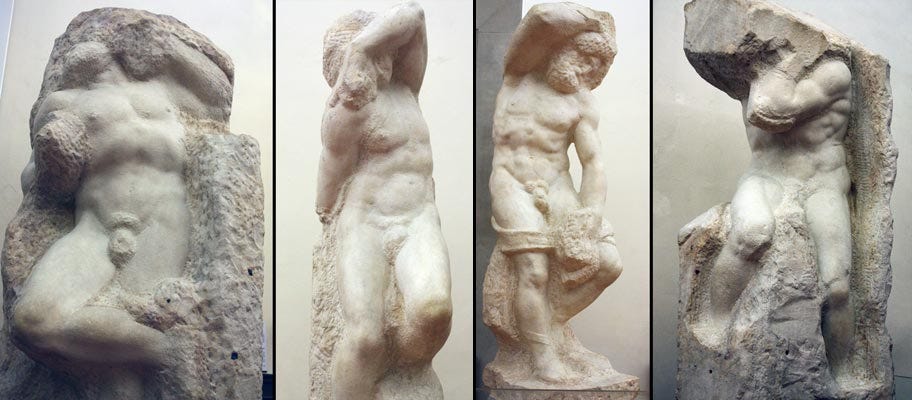
Michelangelo said sculpture is made by taking away, while painting is made by adding. But the belief underneath that line is what moves me. He was convinced the figure was already inside the marble. Whole. Finished. Waiting. The sculptor’s only job was to carve away the excess stone until the figure trapped inside it could finally breathe.
Picture what that actually looked like. Not a gentle refinement. A man with a chisel and a mallet striking the same block for months, sending pieces of what used to be solid crashing to the floor. To anyone watching, it looked like ruin. He was taking a hammer to a perfectly good piece of marble. And he was doing the only thing that would ever set the figure free.
Stay with the parts that ache. The stone cannot see what it’s becoming. It can’t feel the shape waiting just beneath its own surface, has no way of knowing that the thing that feels like violence is the most precise kind of love it will ever receive. And the figure cannot free itself. It’s right there, fully formed, and completely unable to step out of the stone on its own. Someone has to see it first. Someone has to be willing to pick up the chisel and start taking things away.
You are not a block that needs optimizing. You are not stone to be polished into a smoother version of the same stone. The person you’re becoming is already in there, and the only way out is for something to carve away the rest. It will feel like loss. From the inside, it will look like someone destroying what you spent years building. It is the cut that finally lets you breathe.
The grain that has to fall
Jesus said it in terms a farmer couldn’t argue with.
“Unless a grain of wheat falls to the ground and dies, it remains by itself. But if it dies, it produces much fruit” (John 12:24, CSB).
He didn’t say the seed needs better conditions. More sun, richer soil, a longer season. The seed already contains the whole harvest. The only thing standing between the seed and the field is the seed’s own intactness, its refusal to break open. In that moment, staying whole is the problem. It has to lose the form it’s in to become what it was carrying the entire time.
Here’s why that’s so hard. The seed clings to its form because the form is the only thing it has ever known how to be. The form feels like control. As long as it stays a seed, it knows exactly what it is and exactly what comes next. That’s the bargain. Certainty in exchange for a future. The shape that got you here whispers that it’s the only safe way forward, that your history is your strategy, that the way you’ve always done it is the way you’ll keep moving.
But protecting your history and expanding your potential are not the same project. They’re usually opposites. When you guard the form, you get exactly one future: more of the form. When you commit to who you’re becoming before you can see how, the strategies multiply. You stop defending what you already know and become a learner again. You take the swing you’d never take while you were protecting your record. The mess you were avoiding turns out to be the room where all the options were hiding.
Adam Grant puts it plainly: ground your identity in being willing to change your mind, not in being right.
This is BE → DO → HAVE in its rawest form.
Decide who you’re becoming first, and the what and the how stop being a cage and start being a frontier.
This is the pattern underneath the whole story. Death before resurrection. Exile before return. Three days in the dark before the stone moves. Paul writes that Christ “emptied himself” on the way to becoming what he came to be (Philippians 2:7, CSB). The word is kenosis. Self-emptying. Not self-improvement. Not optimization. Emptying.
Pete Scazzero names the human version. In the disorienting in-between seasons, God strips away the false self and empties us, and the emptying has one purpose: to make room for something new. We hate those seasons because nothing visible is being produced. No metric is moving. So we rush to announce the new beginning and skip the part where something actually has to end. But you cannot become a new self while maintaining the old one at full capacity. There’s a middle that feels like loss and turns out to be the most important formation of your life.
That middle is the one place optimization can’t follow you. There’s nothing to improve there. Only something to release.
This is the work coaching makes possible. Not a better system. A witness for the part of the work that can’t be systematized, someone who can see the figure in the stone before you can and help you hold the chisel. If something is stirring as you read, that’s the conversation I’d welcome: joshorwick.com/coaching
Becoming someone you’re not yet
A line from my coaching training reorganized how I think about all of this.
Maximum value isn’t a better result. It’s full participation. And full participation means becoming whoever you need to become to keep the commitment you’ve made.
The gap between you and your next season was never a competence gap. You have competence to spare. It’s a being gap. The life you say you want requires a version of you that doesn’t exist yet, and that version can’t be bolted onto the current one. The current one has to give ground.
I learned this the year I took my family to Maui because I thought rest was all I needed.
I sat in the airport before the flight, anxious, and couldn’t name why. My out of office was on and I kept checking my phone anyway, hunting for something to answer. By the fourth morning I got up before sunrise, drove the coast alone, sat on the rocks at Kapalua, and watched one of the most beautiful sunrises I’d ever seen. And I felt nothing. Not peace. Not gratitude. Just numb. The thought that surfaced wondered what I had done to myself that I can’t even enjoy this anymore.
The shift never came that morning. It came the next morning at a little spot in Kihei, where stray chickens kept wandering up to the tables and my daughters thought it was the funniest thing they’d ever seen. We sat there laughing at chickens, and for a few minutes nothing else existed. No platform. No problem to solve. Just presence. I had built a life so optimized I’d lost the ability to be alive inside it. The thing that had to die wasn’t on my calendar. It was the belief that I had to earn the right to enjoy my own life.

The question
What are you holding onto that’s keeping your next season from arriving?
Don’t take the first answer. The first one is the decoy, the thing you’d gladly release because it costs you nothing. Sit until you find the one you flinch from. The flinch is the map.
Next week I’m doing this differently. Instead of writing about the work, I’ll walk you through the questions I’d actually ask in a session, with room to sit in each one. It’ll read less like an essay and more like a conversation. Come honest.
This is Part 3 of the arc on what success quietly costs. If it found you, send it to one leader who’s been optimizing a problem optimization can’t reach. And if someone sent it to you, you can subscribe and get the next one in your inbox.