

The Question You Can’t Google
On the simple question standing between you and the gap you said you wanted to love.


Last week, you were in the gap.
Not in theory. Specifically. The thing you want to build. The leader you want to become. The marriage you want to come home to. The distance between who you are right now and who you’d have to become to live what you declared.
You had four options on the table: settle, inflate, close it through willpower, or love it.
And then the week ended.
If you’re anything like the leaders I work with, somewhere between that ending and this moment, the vision got translated.
How do I get from here to there? What’s the plan? What’s the timeline? What’s the first move?
All real questions. All the wrong ones.
Because the question actually standing between you and loving the gap isn’t a how-to. It’s simpler than that. Obvious, even. You already know what it is. You’ve been carrying it for a while.
You’ve just been translating it into something else.
Welcome to Leading in the Tension.
I’m Josh. I’ve spent two decades building systems for high-performing teams and the last several years learning what those systems can’t build on their own. This is the follow-through on last week. And the simple question most leaders avoid on purpose.
The question that changes everything is rarely the clever one.
I’ve been trained to ask questions for a living. The thing that still surprises me is that the questions that actually move people aren’t the sharp ones. The insightful ones. The ones that would make a good headline.
The questions that move people are stupidly simple.
“Do you want to get well?”
“What do you want me to do for you?”
“Who do you say that I am?”
Those are three questions from Jesus. Not one of them is clever. All three are uncomfortable. All three cost the person being asked something they were protecting.
That’s the signature of a question that changes things.
A simple question that exposes what you’ve been protecting.
Why simple questions are so hard to hear.
Arthur Brooks, in his new book The Meaning of Your Life, makes an argument I can’t stop sitting with since I heard him teach it at Leadership Labs.
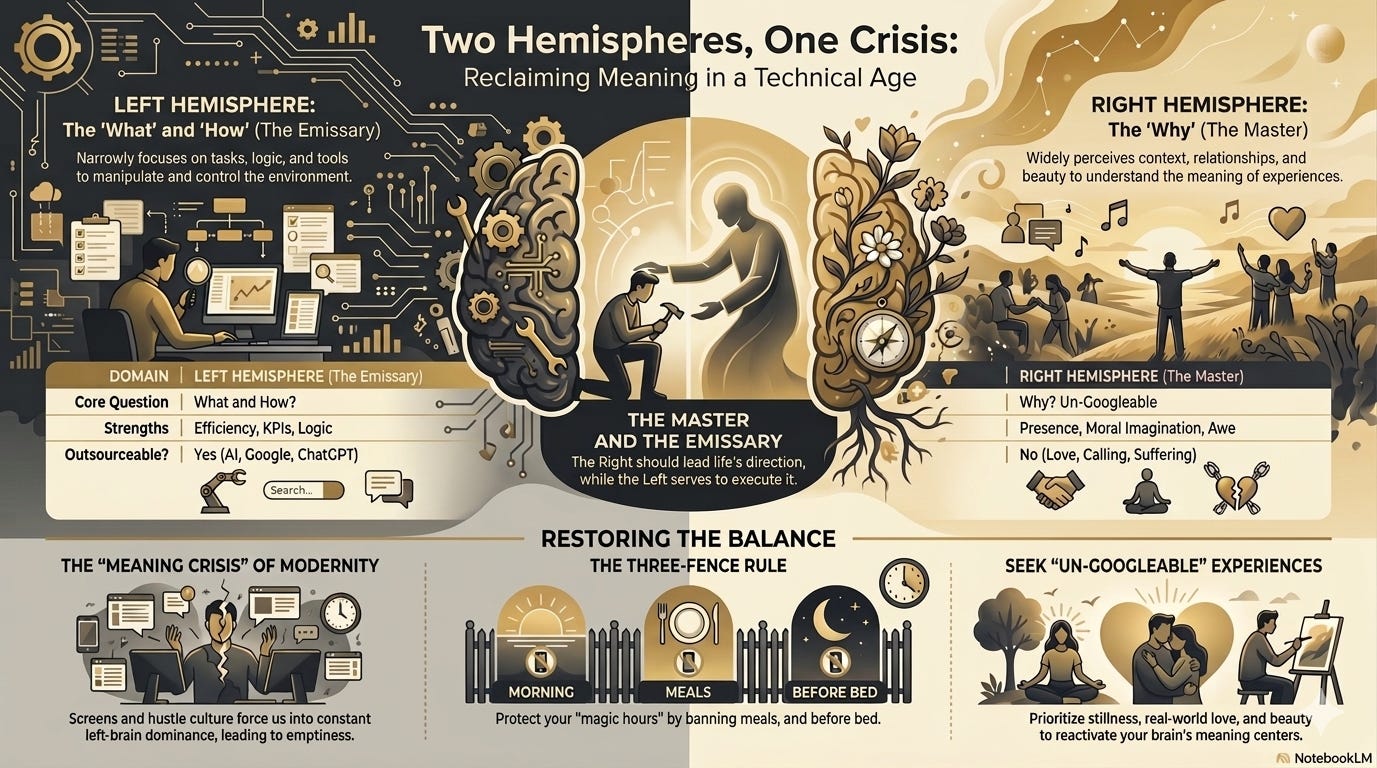
Your brain has two hemispheres. Each asks a different kind of question.
The left asks what and how. What should I do next? How do I get there? How do I optimize? It’s the engine of tasks and technology, roadmaps and KPIs, everything Google can answer for you.
The right asks why. Why am I here? Why does this matter? What would I give my life for? It holds mystery, meaning, coherence. The questions with no lookable answer.
Brooks’ claim, drawing on a broader body of neuroscience, is that modern life has trained us to live almost exclusively on the left side. Phones. Hustle culture. Optimization stacks. AI. We’ve built an economy of what and how. And we’ve quietly walled off the hemisphere that holds why.
He calls it “the problem of the age.”
I think he’s right. And I think it shows up in the gap before it shows up anywhere else.
When you sat with the gap last week and started looking for the first move, you reached left. That’s fine. You’re going to need the left brain. Your calendar needs it. Your team needs it. Your Monday morning needs it.
But the question standing between you and loving the gap isn’t a left-brain question. It’s a right-brain question you’ve been translating into a how.
The translation you’ve been running.
I watch this constantly.
The gap is asking, Who are you willing to become?
Leaders translate it into, How do I get promoted?
The gap is asking, What are you making this for?
They translate it into, What’s the next move?
The gap is asking, What are you capable of?
Jason Jaggard has named this dynamic for years. Most high performers, he says, are operating from a very limited vision for their future. Not because they can’t see more. Because they’ve trained themselves to ask questions that only their current hemisphere can answer. How can I be the best? is a left-brain question. It’s comparative. It’s measurable. You can win it. What you can’t do is let it form you.
What am I capable of? is a different hemisphere. It can’t be won. It can only be lived into.
The tragedy isn’t that leaders are asking bad questions. It’s that they’re translating the good ones into the only hemisphere they can currently hear from.
A saying from the firm.
Don’t should on yourself.
It sounds like a joke. It isn’t.
Should is the left hemisphere’s favorite operator. It sounds like wisdom. It’s actually obligation. It takes every question you could ask about who you’re becoming and reduces it to a decision about whether you’re complying.
Should I take the meeting? Should I push back? Should I make the hire?
Every one of those is a calendar question dressed up as a formation question.
The question underneath, the one you’re not letting yourself ask, sounds different.
Could I become someone whose life doesn’t require those meetings?
Could I build a practice where pushing back isn’t a crisis?
Could the gap be the thing that’s forming me, not the thing I’m trying to eliminate?
Same life. Different hemisphere. Different question. Different becoming.
Why you’ve been avoiding it.
Here’s what I want to name carefully, because this is the part that matters.
You haven’t been avoiding the question because you don’t know what it is. You’ve been avoiding it because you already know what it will cost.
If you ask what am I capable of, you don’t get to stay where you are.
If you ask what’s this gap forming me into, you can’t treat it like a failure anymore.
If you ask could I become someone who receives this life instead of extracts it, you have to stop performing your current version.
That cost is real. I’m not going to minimize it. The leaders I work with feel that cost precisely. And feeling it is often what brings them to the conversation in the first place.
But here’s the part we rarely name.
You’ve already been paying a cost. For years, probably. The cost of living almost-clear. The cost of translating every formation question into a strategy question. The cost of asking a hemisphere that cannot form you to produce the life only the other hemisphere knows how to recognize.
The cost of the simple question is one-time.
The cost of avoiding it compounds.
This is what coaching is. Not a sharper calendar. Not a better strategy. Someone trained to ask you the question you’ve been translating, and to hold you in it long enough for the other hemisphere to answer.
I have coaching spots opening in May. If you need someone to ask you the question you’ve been avoiding — reply and let’s set up a conversation. joshorwick.com/coaching
The practice of not translating.
When you catch yourself asking a how, pause. Ask what the why underneath it is.
When you catch yourself asking a should, pause. Ask what the could underneath it is.
When you reach for a strategy, pause. Ask what you’d have to become for the strategy to matter.
You’re not abandoning the left hemisphere. You need it. Your team needs it. The vision you declared last week needs it. Brooks is clear, and I agree. The goal isn’t to reject what and how. It’s to stop letting them do all the work.
The goal is to recover the hemisphere that holds the why.
To let a simple question sit in the gap long enough that you can actually hear it.
To stop translating.
What atrophies from disuse can be trained back. That’s not optimism. That’s formation. The right hemisphere isn’t a personality type. It’s a muscle you stopped using. Muscles come back.
This is why formation is never too late.
A note for those with ears to hear.
Paul writes, in Romans 12:2,
“Do not be conformed to this age, but be transformed by the renewing of your mind.”
The Greek for renewing is anakainosis. A root-level remaking. Not optimization. Not improvement. Reconstruction.
I don’t think Paul was writing about hemispheres. But I think he was pointing at the same thing Brooks is describing. A world that trains your mind into a pattern that cannot form you, and a call to be made new at the root. To be transformed means something in the instrument itself has to change. The way you think. The hemisphere you default to. The kind of question you let yourself ask.
If the vision you carry came from outside your current desires — calling, Scripture, a Voice you can’t quite source but can’t quite shake — the gap you’re standing in isn’t a problem to solve. It’s the terrain of transformation.
And the question standing between you and loving that gap is, at the end of the day, a very old one.
Who are you becoming?
You can’t Google that. You can’t strategy your way across it. You can’t optimize it or hustle it or close it through willpower alone.
You can only ask it honestly. And let the answer form you.
The question I’d leave you with.
What’s the simple question your life has been asking you that you’ve been translating into a should?
Don’t answer it quickly. Don’t translate it again.
Sit with it. Stay in the gap.
Let it form you.

Next week: asking the question is the first move. There’s usually something specific that keeps leaders from answering it. And most of the time, it’s not what they think. We’ll go there.
If this resonated, forward it to one leader who’s been translating right-brain questions into left-brain hows for too long. If someone forwarded this to you, subscribe here.