
What If It Worked?
THE UNMAKING, Part 4. What changes when belief comes before proof.

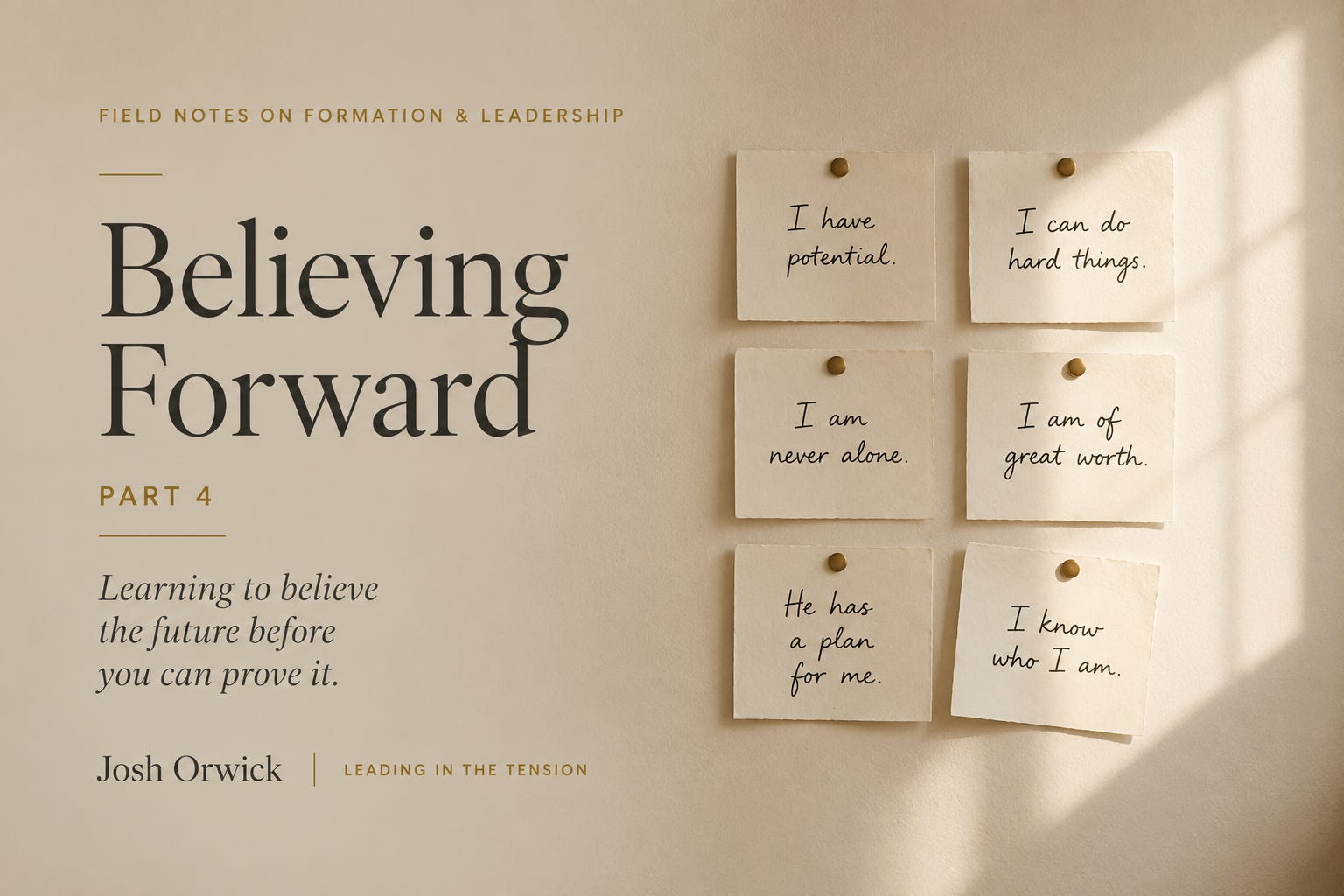
My daughter has six sentences on her wall that most adults spend a lifetime trying to earn.
I have potential. I can do hard things. I am never alone. I am of great worth. He has a plan for me. I know who I am.
She didn’t earn one of them, and the sentences aren’t the point. What forms her is the belief underneath them. We put those words on her wall because we already see who she’s becoming, and a child grows into the belief long before she can read the proof of it. The words just carry the conviction into the room.
I stood in her room today, home from a couple of days in Atlanta, and I smiled. Because I’d spent the whole weekend learning to do for myself the thing I already do for my daughter without thinking about it. Believe in who someone is becoming before they can see it themselves. Then watch the belief go to work.
I was in Atlanta with my team, Novus Global. A room full of coaches holding up the mirror for each other and upgrading the ask of what we’re capable of, individually and together. The founder, Jason Jaggard, said the thing he’s most obsessed with is the excavation of human potential. And in the moment, I immediately was flooded with a sense of connection to a future that I had become almost numb to. Excavation as power, as potential, as the generation of a present from a new future not yet fully discovered. You explore with expectant curiosity, because you already believe something is there worth uncovering.
That’s the posture I want to lead from now. And it’s the turn this whole series has been building toward. For weeks we’ve sat in the unmaking, the weight of what was, the identity that had to come apart. This is where it flips. I’m not mourning what came apart anymore. I’m starting to see what it was making room for.
Welcome to Leading in the Tension. I’m Josh. I coach mission-driven leaders living in the gap between who they are and who they’re becoming, and this is Part 4 of The Unmaking.
We already know how to do this
This is what I keep coming back to. We already know how to speak belief before the proof. We do it for the people we love without a second thought. No parent waits for a track record before telling a child she’s of great worth. You say it because you can see her, and the seeing comes before the evidence.
Then we grow up and quietly reverse it. We decide belief is something you’re allowed to hold only after the evidence clears, and until then it’s naïve. We speak generous, unproven futures over our kids every morning and won’t speak one of them over what we’re building ourselves.
The philosopher William James argued something like this over a century ago in The Will to Believe. Some truths won’t show up as evidence until after you’ve committed to them. Waiting for proof first isn’t neutral. It’s a choice, and often the one that keeps the proof from ever arriving.
That’s what was happening in that room in Atlanta. It’s what happens on my daughter’s wall every morning. The belief goes first, and it builds the thing it believes in.
The question I stopped asking
I noticed something about myself this weekend.
I’m fluent in one question, and I never ask its twin. I can run the failure questions in my sleep. What if I’m not ready? What if I’m wrong about this? What if I reach for it and it doesn’t hold? I’ve got a hundred careful versions, and every one of them sounds like wisdom.
The question I don’t ask is the one that actually generates something.
What would happen if it worked?
Not as a fantasy. As a serious question. If the belief were true, if the thing I’m building became what I actually think it could become, who would that require me to be, and what would I start doing this week to meet it? The failure question keeps me safe and still. This one pulls me forward into a future I’d have to grow to inhabit. I let the safe question set the size of what I’d attempt for a year and I’m done handing it that job.
The leaders I coach live in the same asymmetry. They’re not missing a skill. They’re running the failure question on a loop and calling it strategy, and the vision shrinks to whatever feels guaranteed. The moment someone lets themselves ask what would happen if it worked, the room changes. The future stops being a threat to manage and becomes a place to move toward.
This is what coaching does. It gets the future question asked out loud, usually for the first time, and holds the belief steady while you grow into it. Not advice. Not another framework. Someone who sees more capacity in you than you can currently see in yourself, and won’t let you shrink the vision back down to safe. If something is stirring, I’d welcome the conversation. Vision Calls are open.
You can’t see it from the inside
For a long time I thought this kind of belief was something you generated alone. Grit your teeth, affirm harder, believe in yourself. It doesn’t work, and I finally understand why. You can’t be the one who sees the unseen version of you. You’re standing inside it. You need people outside of it.
That’s why I coach with a team instead of on my own. With Novus Global, our coaching spans a landscape of high-performers, partnering with teams and individuals alike, from the boardrooms of the Fortune 500 to the arenas of elite athletes and professional artists. We work at the intersection of performance, character, and wisdom, not just helping clients get what they want, but asking what’s worth wanting. To move beyond what feels possible, someone has to see more than the person can currently see in themselves, and believe it out loud until they can carry it. That’s what excavation is. It’s how potential gets called forward instead of just admired.
I spent most of last year believing I had to build this and prove this by myself. A room full of people upgrading the ask of what we’re capable of together reminded me there is a better way. You don’t generate a future alone. You do it with people who keep believing bigger things over you than you could hold on your own.
Believing forward
So this is the reframe I’m carrying home.
Now faith is the reality of what is hoped for, the proof of what is not seen. — Hebrews 11:1 (CSB)
Sit with that for a second. Faith isn’t the thing you reach for when the evidence runs out. Faith is the evidence. It’s the substance you get to hold now of a future that hasn’t shown up yet. Scripture doesn’t treat believing forward as naïve. It treats it as the most solid ground a person can stand on.
The whole chapter is a roll call of people who moved on that ground. When God called Abraham, he “obeyed and set out for a place that he was going to receive as an inheritance. He went out, even though he did not know where he was going” (Hebrews 11:8, CSB). He didn’t get a map. He got a voice and a belief, and he moved. The destination became real because he walked toward it before he could see it.
And here is the line that keeps running into my own set of beliefs. These same people “died in faith, although they had not received the things that were promised. But they saw them from a distance, greeted them” (Hebrews 11:13, CSB). They never held the proof. They never stopped believing forward either. Logically, in this world, that feels impossible. But faith generates and then becomes more than the restraint.
They saw the promise from a distance and greeted it like an old friend, as if it were already theirs, because to them it already was. That is the most generative posture a person can take toward their own life. Greeting a future you cannot yet touch as though it is already on its way to you.
This is the faith I was raised on and the faith I keep relearning. Not certainty. Belief that moves. The willingness to walk toward a good future God has spoken over you before a single piece of it is in your hands.
The words on my daughter’s wall are a small daily version of that same faith. We tell her who she’s becoming before she can prove it, and the belief forms her. It is not meant to be easy or enabling, but empowering a vision of potential beyond what sits as practical on the surface.
The invitation for all of us is to stop withholding that from ourselves, and to start speaking it over each other, out loud, bigger than the evidence in front of us.
So I’ll hand you the question I’ve been avoiding, the one I’m finally asking.
What would happen if it worked? If the future you keep protecting yourself from actually came true, who would you have to become to meet it, and what would you begin today?
Don’t answer it small. Answer it like someone already believes it about you.
Next week: once you start believing forward, a harder question shows up. Not what you should do next. Who you’re becoming. Because becoming comes first, and almost everyone has the sequence backwards.
This is Part 4 of The Unmaking. If it named something for you, forward it to one leader who’s been asking the failure question too long. If someone forwarded this to you, subscribe here.
Josh Orwick is an executive coach with Novus Global, part of a team that serves teams and individuals in discovering what comes after high performance. If you are interested in exploring what you are capable of and creating a life that is thrilling and beyond what feels possible, reach out for a powerful conversation. https://lp.novus.global/joshorwick
The question you stopped asking is the one I avoid too, the failure question feels like responsibility when really it's just the safer one to hold. I keep the vision small enough to feel guaranteed and call it realistic. What did you actually start doing differently once you let yourself ask what would happen if it worked?