
You've Been Accepting a Ceiling That Isn't Yours
Part 6 of 6: What I kept at a distance — and what changed when I stopped.

I have seen what reconstruction looks like.
Not physical healing. The other kind. The kind where someone’s internal belief rebuilds itself after years of collapse. Where a relationship that should have been over finds its way back to wholeness. Where hope gets created in places that had every reason to give up on it.
I carry those stories. They are the foundation of my fidelity to this work. My belief that transformation is real isn’t an optimistic theory. It is built on watching things become possible that had no business being possible.
And yet there is still something in me, quiet and mostly invisible, that places a lid on my own vision.
Not loudly. Not dramatically. Just the persistent, low-grade assumption that what I have seen happen for others belongs to them. That those moments of reconstruction were their grace. Their season. Their story. That what I witnessed in someone else is inspiration, not instruction.
I finished the newsletter last week about worthiness. About why belief has to come before competence. About why you don’t wait to become. And then I went back to waiting. Not consciously. Just resuming the ordinary patterns of someone who hasn’t fully entered what they wrote.
I had written something true. I was still living from Normal.
That gap is what nobody addresses in the final week of a series about transformation. And it might be the only gap that matters.
Welcome to Leading in the Tension.
If you’ve ever seen what’s possible in someone else and quietly decided it wasn’t meant for you, you’re in the right place.
I’m Josh. I’ve spent two decades leading across franchise operations, church ministry, and higher education. This newsletter is about the tensions most leaders carry silently and what becomes possible when we stop trying to resolve them and start building from within them.
New here? Start with Part 1: What Have You Normalized That Isn’t Actually True?
Last week, we asked why it’s so hard to step into the being, even when the competence is already there. We named the belief gap. We named the coat that becomes the cage.
This week is the integration. Not a summary. A reckoning.
This is Part 6 of 6 of the True vs. Normal series.
The Stories We Keep at a Distance
There’s a pattern I’ve noticed. In myself more than anywhere else.
Someone shares a story of impossibility broken. A business built from nothing. A body restored against every prediction. Hope created in a place of serious suffering. Something stirs when I hear it. I lean forward. I recognize what’s possible.
And then I place it at a careful distance.
Not because I don’t believe it happened. Because I’ve already decided, quietly, that it happened for them. Their gift. Their season. Their particular grace. Not mine to enter.
We do this constantly. We hear about someone who built the thing we’re building and tell ourselves their situation was different. We read about a leader who found the margin we’re desperate for and decide they had advantages we don’t. We see people step into the exact vision we’ve been carrying and find a reason it applies to them and not to us.
This distance isn’t accidental. It’s protective.
Jason Jaggard names it precisely: Most high performers are “typically operating from a very limited vision for their future. It doesn’t seem limited to them. And it especially doesn’t seem limited to those around them. But it’s limited all the same.”
The limitation isn’t obvious. It doesn’t look like giving up. It looks like wisdom. Like patience. Like appropriate humility. The story that “isn’t for me” doesn’t feel like a cage. It feels like realistic self-assessment.
But six weeks of writing this series has made something plain.
The stories we keep at a distance aren’t stories of impossibility. They’re stories we’ve decided, without examining the decision, aren’t ours to enter.
That’s not discernment. That’s the fence.
The Fence We Built Without Realizing It
Every one of us carries an intuitive sense of what’s possible. A boundary. A circle.
Inside the fence: what feels achievable.
Outside: what feels invisible, impossible, not meant for people like me.
The fence does two things at once. It hides possibilities from view, because our minds don’t spend energy on what they’ve classified as out of reach. And it convinces us it’s permanent. Fixed. Just how things are.
Here’s the nuance worth holding: not every fence should come down.
G.K. Chesterton argued that you should never remove a fence until you understand why it was built. Some constraints are real. Some limits are given, not assumed. Some boundaries exist because wisdom built them.
The True vs. Normal practice isn’t about tearing everything down. It’s about learning to ask: why is this fence here? Was it built by wisdom? Or was it built by exhaustion, by repetition, by the accumulated weight of someone else’s script?
Most of the fences I’ve discovered in these six weeks weren’t built by wisdom. They were built by the slow accumulation of living as if my Normal were True.
The exhaustion I called commitment. The trade-off I called sacrifice. The doing I called faithfulness. The waiting I called discernment.
When I finally named them, I could see them for what they were.
What Happened When I Named Mine
In January, I sat in a room full of people learning the same coaching skills I was learning.
I could hold the conversation. I could ask the right questions. I could feel when something important was surfacing for the person across from me.
What I couldn’t do was believe I was the kind of person who had something to offer.
Not because I lacked skill. The skill was there. The gap wasn’t capability. It was worthiness. I had built a practice, declared an identity, written twenty-something weeks about formation. And underneath all of it, I was still operating from a Normal that said: people like me don’t get to have what they’re describing.
I hadn’t examined that belief. I didn’t even know it was a belief. It felt like reality.
My coach didn’t ask me what I needed to do differently. She asked what I was telling myself was impossible. When I started listing those things, she asked something much simpler.
Is that actually true?
Not “have you worked hard enough?” Not “what’s your strategy?” Just: Is that actually true?
That question cracked something open. Because when I sat with it long enough, I couldn’t justify most of what I had been treating as given. The beliefs were real. The ceiling was not.
That’s the moment this series has been building toward. Not the intellectual version of the question. The version that costs something. The version where you discover that the lid on your vision wasn’t placed there by reality. It was placed there by a story you stopped questioning so long ago you forgot it was a story.
This is the kind of conversation that coaching makes possible. Not advice. Not a framework. The kind where your beliefs about what’s possible come to the surface because you’re trying to grow past them. That’s where the real work happens. If something has been stirring over these six weeks and you want to have that conversation, I’d welcome it: joshorwick.com/coaching
Building from True
Six weeks of questioning is a foundation. Foundations are meant to build on.
Here’s what the integration asks of you. When you encounter a constraint that feels like reality, and you will, probably this week, run it through four movements.
Identify it. Not vaguely. Specifically. What is the actual belief? Name it plainly, the way you’d say it to someone who wasn’t going to let you be vague.
Question it. Not “is it hard” or “is it risky.” Is it true? Who built this fence? Was it wisdom, or was it exhaustion? Was it discernment, or was it accumulated assumption wearing discernment’s clothes?
Reclaim the possibility. If it isn’t true, what opens? This isn’t a visualization exercise. It’s a real question about what you’d step into if this weren’t a given.
Take one step. Not the whole journey. One movement toward True today. One email. One conversation. One thing your Normal told you was premature.
The fence moves when you approach it. Not when you think about approaching it.
The reason this is a practice and not a one-time breakthrough is that Normal regenerates. Culture will fill the space you cleared. Old scripts will re-run the moment you stop paying attention. Formation is the work of catching that, over and over, and asking again: is this True, or is this just what I’ve accepted?
There Is More on the Other Side
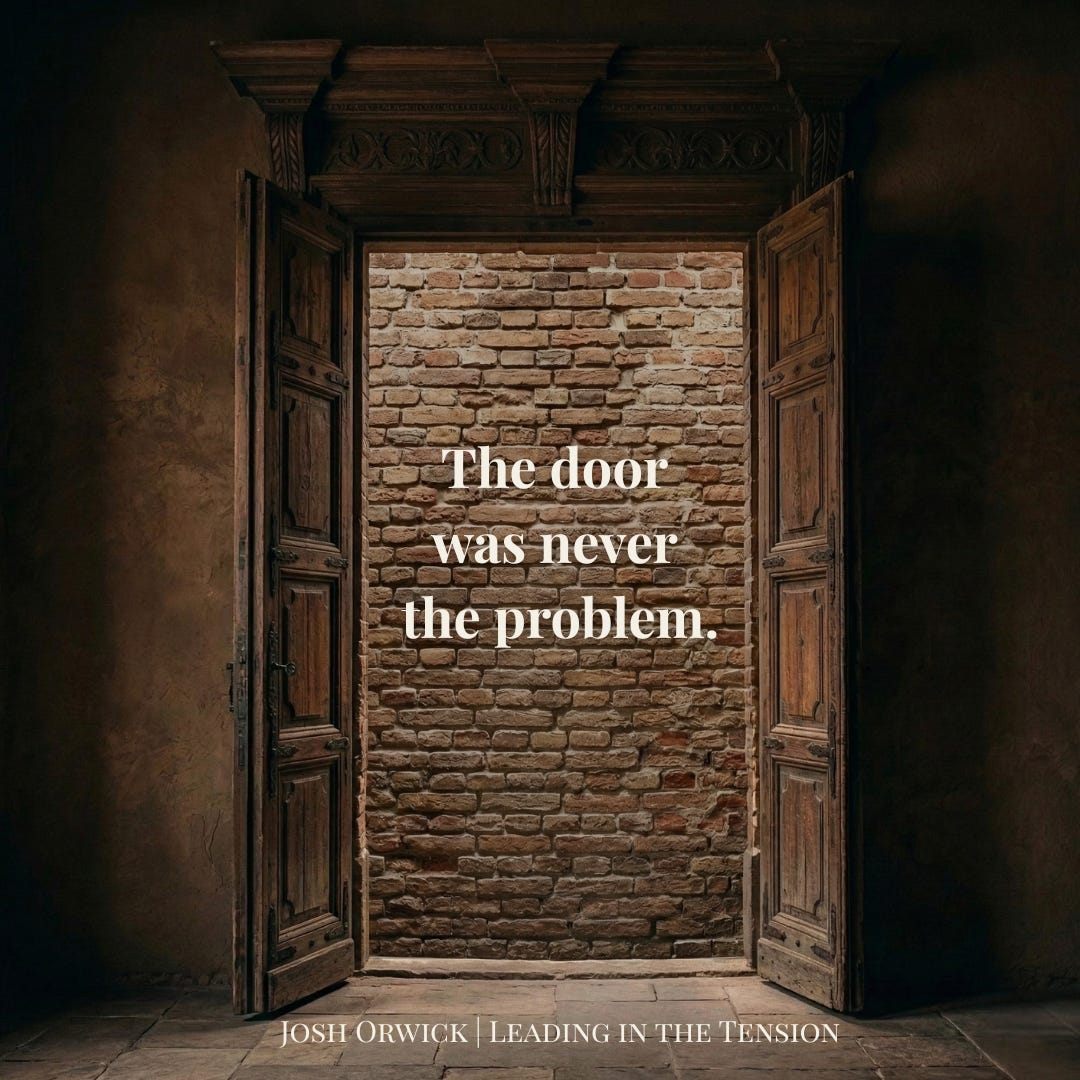
Normal isn’t just a theory. It’s a ceiling.
And the ceiling isn’t structural. It’s assumed. Which means the space above it is already there. Already available. Not something you have to earn or construct or wait for the right season to access.
Paul writes in Ephesians 3:20 about the God who is able to do immeasurably more than all we ask or imagine. Not “will eventually do.” Able to do. Present tense. The capacity is already there.
The gap between what we’re living and what’s available isn’t God’s hesitation. It’s our assumption that the ceiling is real.
The kingdom doesn’t just challenge your assumptions. It relocates the floor. What you’ve been calling your ceiling is the floor of something else. There is more available. Not as inspiration. As inheritance.
Ephesians 2:10 says we are God’s handiwork, created in Christ Jesus to do good works, which God prepared in advance for us to do. The works were prepared. Not the worth. That was already settled. The doing flows from the being. Your calling was never meant to be the source of your identity. It was meant to be the overflow of it.
The healing I’ve watched happen in people. The reconstruction of belief. The restoration of relationships. The wholeness that came back after breaking. None of it looked like what they thought was possible. All of it was available before they could see it.
Your Normal is not the ceiling of what’s been made available to you.
I want you to feel that before you answer the question below. Not just understand it. Feel it. Because the work that comes next isn’t hard because the goal is far away. It’s hard because the goal is close and we keep deciding, quietly, without examining the decision, that it isn’t for us.
It is for you.

The Question
After six weeks of questioning: what’s the one Normal you’re ready to release?
And what’s the True you’re ready to build from instead?
Don’t answer that like a thought experiment. Answer it like someone who’s about to do something with the answer.
You just finished six weeks of questioning. Now let’s build.
This week, I’m making a free 5-Day True vs. Normal Challenge available to anyone who wants it. Five days of prompts built from the integration framework above. Designed to help you move from naming what you’ve normalized to taking the first step toward True.
Day one takes fifteen minutes.
Reply to this email or send me a DM with “I’m in” and I’ll send it directly to you.
If the challenge surfaces something you want to work through with someone — not just read about, but actually excavate — Discovery Calls are open. That’s what coaching is built for: joshorwick.com/coaching

What’s next: The series is complete. The work isn’t. Starting next week, we begin something new: what you build when you stop constructing from Normal. The series was about questioning what you’ve accepted. What comes next is about living from what you found.
This is Part 6 of 6 of the True vs. Normal series. If this landed, forward it to one leader who has been carrying something they haven’t named yet. That’s how this work reaches the people who need it most.
If someone forwarded this to you, you can subscribe here to get these reflections every week:
There is so much to process with this excellent series. Your message resonates with me for several reasons. Your story resembles mine. We normalize the stories we tell ourselves, the grind, the thinking, and what others have achieved is not really for us. This is powerful. But, when truth is brought to the equation, and we ask if what we are saying is the truth .... really, the truth, this exposes our thinking and patterns. Through this awareness, we can recognize that there never was a ceiling. Great work!